
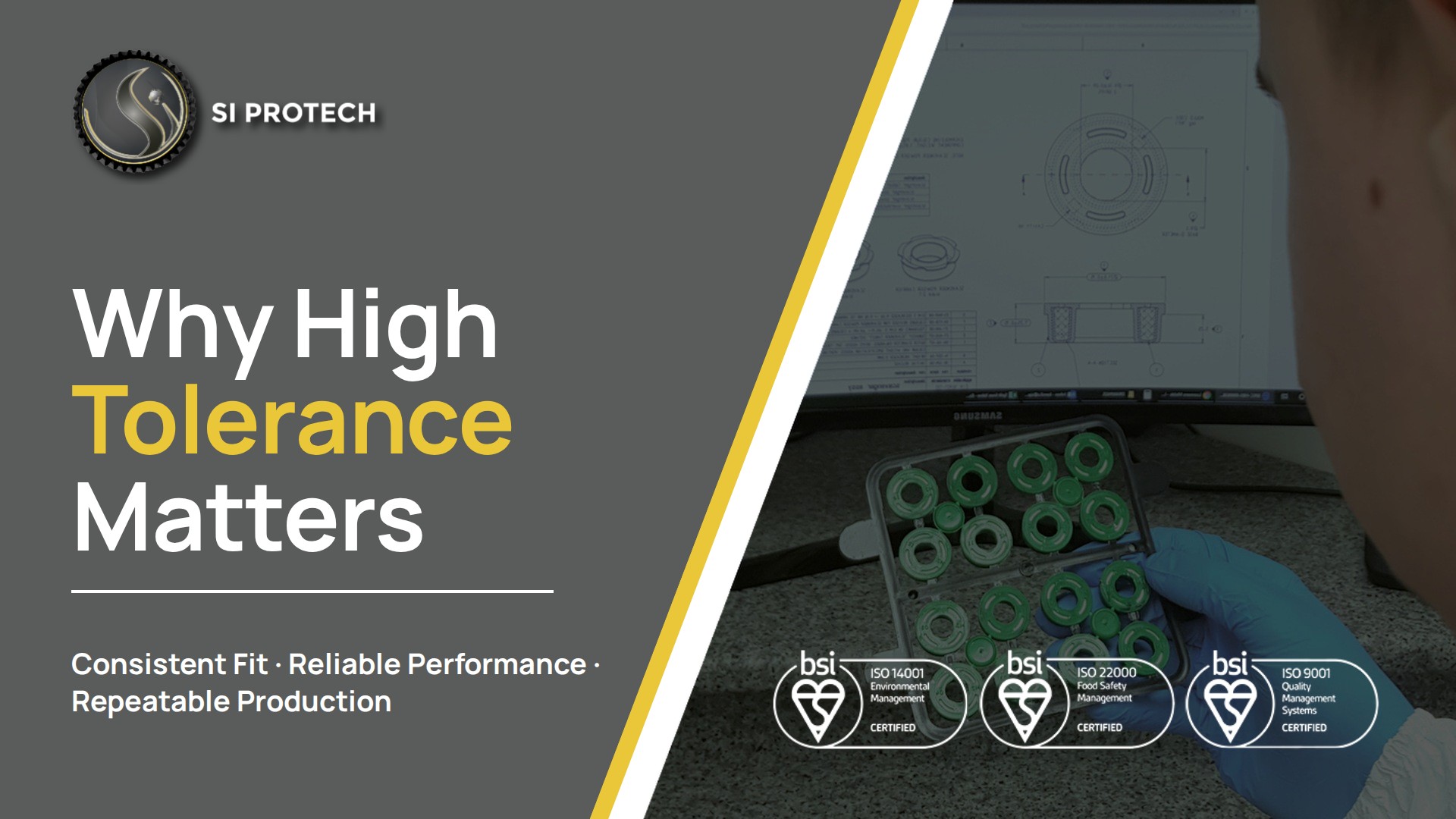
A component can be small, yet its impact on the finished product can be anything but.
For manufacturers relying on high-tolerance plastic components, accuracy isn’t enough on its own – it needs to be repeatable. Even small variations can affect how a component fits, functions and performs.
What does “high tolerance” mean?
Every component drawing specifies dimensions along with a tolerance: the acceptable range of variation around each one. High-tolerance (or tight-tolerance) components are those where that range is very small, often fractions of a millimetre. Closures that must seal reliably, parts that clip or snap together, components in dispensing systems and pharmaceutical packaging and parts that interface with metal assemblies all depend on tight tolerances.
Why small variations cause big problems
A part that is slightly out of tolerance may still look perfect. But in use, it can:
- Fail to fit or assemble correctly
- Leak, bind or wear prematurely
- Slow down automated assembly lines
- Cause rework, rejected batches and delays further down the supply chain
For a buyer, the real cost of an out-of-tolerance part is rarely the part itself. It’s the disruption it causes to their own production.
The benefits of repeatable precision
A component that performs exactly as intended, production run after production run, supports:
- Consistent fit and function
- Reliable performance in demanding applications
- Smoother assembly and production
- Fewer quality issues, delays and unnecessary rework
For the buyer, that means greater confidence that the parts arriving tomorrow will perform as reliably as the parts arriving today.
How tight tolerances are achieved
Holding tight tolerances in injection moulding depends on getting many things right at once:
Design for Manufacture (DFM)
Wall thickness, draft angles, gate location and material choice all affect shrinkage and warpage. Addressing them at the design stage is far easier than correcting them after a tool is made.
Precision tooling
A well-designed, well-maintained mould with balanced cooling is the foundation of dimensional stability.
Process control
Validated process settings and statistical process control (SPC) keep production inside a proven window, so every batch is moulded the same way.
Measurement and inspection
At SI Protech, CMM, laser measurement and advanced inspection systems verify that critical dimensions are being held, with data feeding back into continuous improvement.
Questions to ask your moulding supplier
If your product depends on tight tolerances, it’s worth asking any potential supplier:
- How do you review designs for manufacturability before tooling?
- How are process settings validated and controlled in production?
- What measurement equipment do you use, and how often are critical dimensions checked?
- How is inspection data used to drive improvement?
- What certifications and traceability systems do you have in place?
Clear answers to these questions are a good sign that a supplier can deliver precision consistently, not just occasionally.
How SI Protech can help
At SI Protech (UK) Ltd, we manufacture technically advanced injection moulded components and assemblies, combining precision engineering with robust manufacturing processes to support reliable, repeatable production. Our quality systems are certified by BSI to ISO 9001, ISO 14001 and ISO 22000, and our approach is built on prevention rather than detection.
If you’re sourcing high-tolerance plastic components, get in touch with the SI Protech team to discuss your requirements.